Foresters
Forestry provides material and employment for humans in most parts of the world, with other important benefits in terms of reducing flow from rain that causes floods, in creating diverse landscapes for nature and human recreation, and in sequestering carbon. In PRO-COAST, work on the endearing Red Squirrel provided a fundamental change in thinking on forestry from the Norbury Park Estate in Staffordshire.
The Red Squirrel is a coastal species in southern Britain, surviving on islands but able to recolonise the mainland if the invasive North American Grey Squirrel is removed. The Grey Squirrel carries a pox disease which is fatal to red squirrels and also devastates young native trees, especially oak, beech and maples, which are important for storing carbon as timber. In the Dorset study, opinion in favour of restoring Red Squirrels was overwhelming[RK1] . Then Norbury Park offered a generous loan of traps to remove Grey Squirrels[RK2] .
Visiting Norbury Park was amazing. In contrast to the planting of much forestry as a ‘monoculture’ crop of the same trees, a variety of tree species suitable for the soil and climate had been planted in some woodland compartments. At 7 years after planting, the 10% of trees which were growing most strongly were chosen for the final crop and those in a ‘halo’ around them were cut about 2m above the ground, a process known as ‘pollarding’. The ‘halo-pollarding’ preserves a diversity of trees to keeps the soil and whole woodland rich in nature and disease-free. The trees grow and store carbon about twice as fast as in monocultures of the same species!
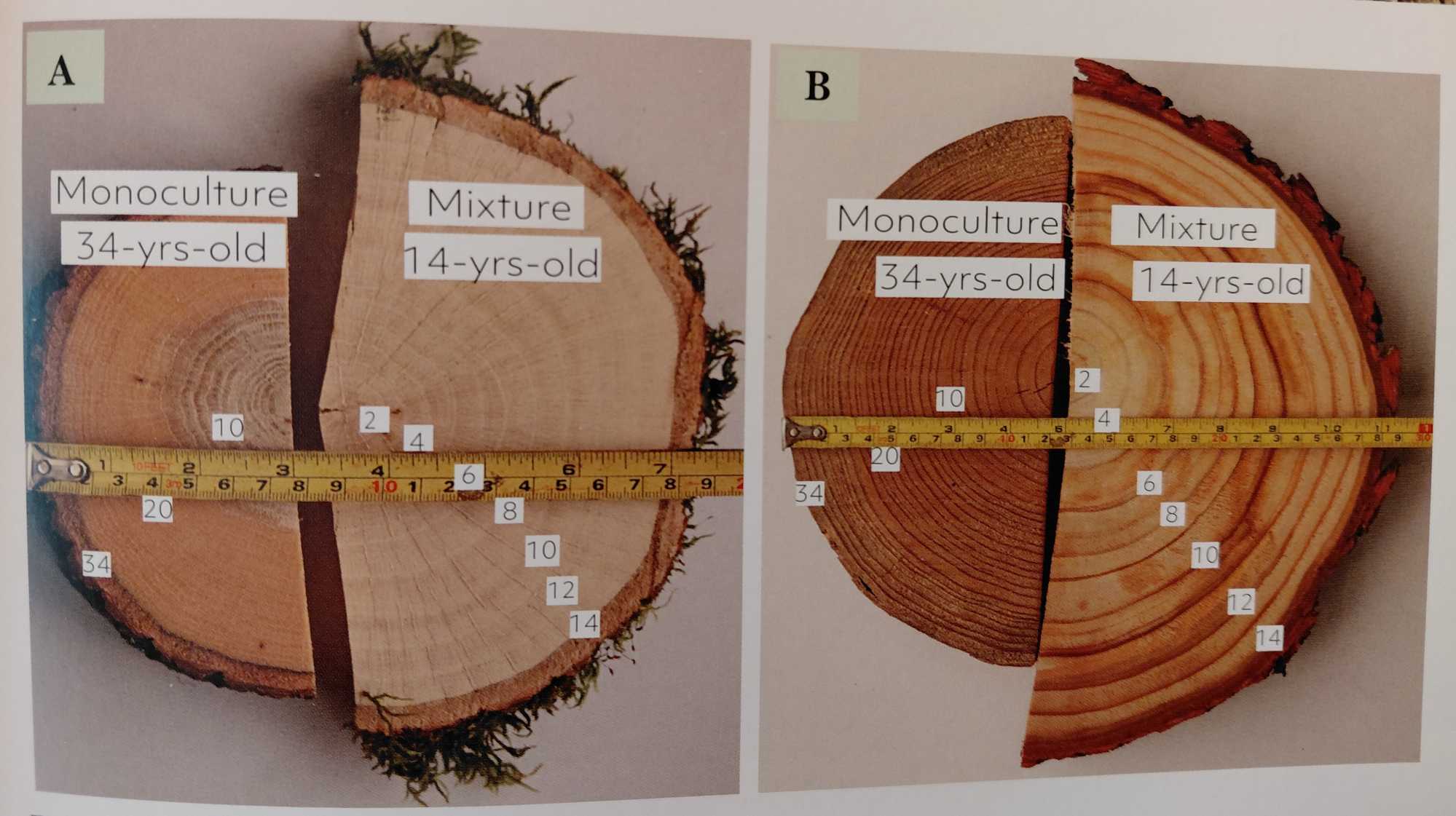
Oak (left) and larch (right) from monoculture and halo-pollarded mixtures © Norbury Park
[RK1]Survey results (e.g. from ppts) need to be prevalent on the page where one lands.
[RK2]Link to trap page on Pro-Coast-Purbeck
My Forest: designed for forest owners and managers to record and manage woodland information. It can be used to map forest areas, record trees and stands, keep notes and track management activities. Link to the tool's website
i-Tree: helps forest managers assess the environmental benefits provided by trees and woodlands. It can estimate factors such as carbon storage, carbon dioxide removal, rainfall interception and air pollution removal. This allows foresters to better understand the wider value of a forest and use this information when making management decisions. Link to i-Tree
Woodland REDS: is a digital tool designed to help woodland managers understand and plan for biodiversity. Users can map their woodland according to the combination of tree species present, which the tool then uses to predict the likelihood of finding particular species, such as grey squirrels, in different areas. The planning function allows managers to model potential changes to their woodland and see how these could affect the predicted distribution of species. Users can also record and map actual species sightings within their woodland. These observations are fed back into the model, helping to improve its predictions over time. This creates a useful feedback loop between woodland management and biodiversity monitoring. By allowing managers to test different scenarios, Woodland REDS can help them make more informed decisions about how to manage their woodland for biodiversity.